24V vs 12V Power Adapters: A Comparison Guide for 36W Device Applications
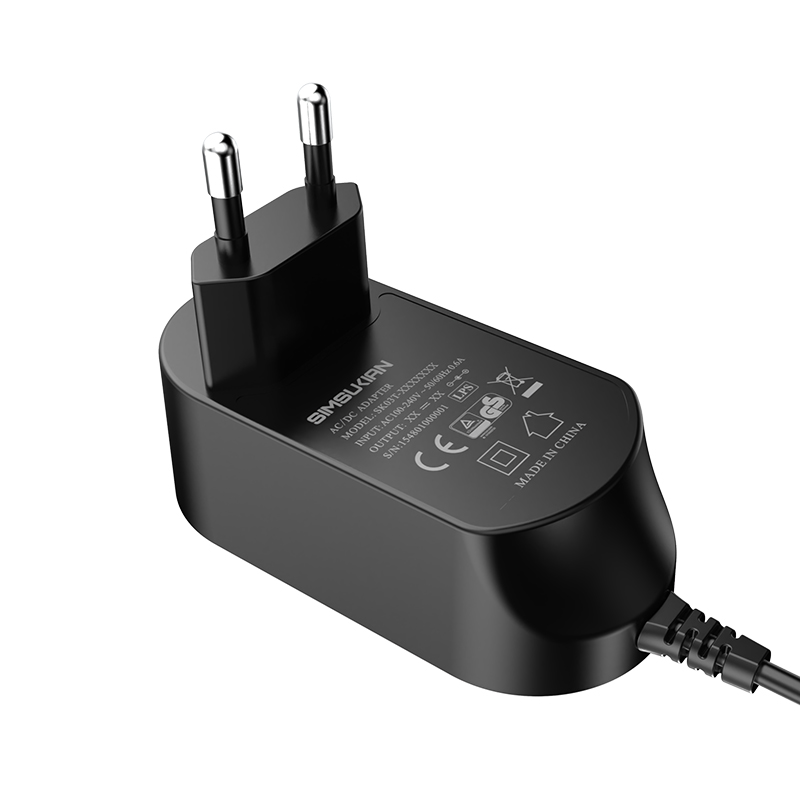
A 24V/1.5A adapter and a 12V/3A adapter both deliver 36W. They are not interchangeable, and the difference is not a question of which one is stronger. The 24V output pushes the same wattage through half the current; the 12V output needs double the current to reach 36W. For a buyer, the decision comes down to five constraints: the device's rated input voltage, the current the load actually draws, the cable and DC connector in use, the AC plug the destination market requires, and the safety and efficiency certificates that market enforces.
This guide compares the two options as documented Simsukian products: the 24V1.5A36W power adapter and the 12V3A36W power adapter, both built on the SK03T 36W platform. The 24V version is documented in EU, UK and Korea plug versions; the 12V version is documented in EU, UK, AU and US plug versions. Both are offered in black and white, both run on the same input range of AC 100–240V 50/60Hz, and both carry the same protection set: short circuit protection, overvoltage protection and overcurrent protection.
Because the two variants share a platform, an enclosure and a certificate portfolio, they can be compared on identical terms rather than across unrelated suppliers. The sections below define the decision problem, place it against the current regulatory background, break down both products, and close with a step-by-step selection process, application scenarios, a comparison table and an FAQ.
The Problem: Identical Wattage, Different Electrical and Market Constraints
A 36W device does not accept a voltage range the way a laptop charger does. Fixed-output AC-DC adapters are built for products that expect a defined DC input, commonly 12V or 24V in industrial, home-appliance, IT, LED and general electronics equipment. That creates four practical constraints a buyer has to resolve before ordering:
- Voltage mismatch is not self-correcting. A device rated for 12V DC that receives 24V is over-volted; a 24V device fed 12V may not start at all. The output voltage has to match the device's rated input before any other parameter is discussed.
- Equal power, unequal current. At 36W, the 24V variant delivers 1.5A while the 12V variant delivers 3A. Lower current means lower resistive loss in the conductor and less voltage drop over distance, which becomes relevant once the adapter sits further from the load or the cable is longer than a short tail.
- Connector and cable load. Higher current at the same power places more demand on the DC plug and the cable gauge. The 12V3A configuration is a higher-current design and should be paired with a conductor and DC plug sized for it. On the SK03T platform, cable length, cable type and DC plug size are all covered by OEM/ODM customization.
- Market constraints attach to the SKU, not to the wattage. Plug type and the mandatory certificate set change by destination. A 36W design that is fully documented for the EU may still need a country-specific certificate for Korea or Australia before it can legally be placed on that market.
Decision rule: match voltage first, then confirm current capability at the required load, then confirm the plug type and certificate set for the destination market. Never select a 36W adapter on wattage alone.
Industry Background: Efficiency and Safety Rules Now Shape the Choice
The 36W fixed-output adapter is a mature product category sitting inside a market that is still expanding. The global power adapter market was valued at USD 26.65 billion in 2025 and is projected to reach USD 46.14 billion by 2034 (Dataintelo, Power Adapter Market Research Report 2034). Growth in the adjacent fast-charging segment is faster still: the GaN charger market was USD 1.10 billion in 2023 and is forecast to reach USD 4.22 billion by 2030, a 19.9% CAGR (Next Move Strategy Consulting).
Two regulatory shifts matter more to a 36W buyer than market size does.
Hazard-based safety. IEC 62368-1 4th Edition (2023), effective 26 May 2023, is the mandatory hazard-based safety standard for audio/video and ICT power supplies, replacing the legacy 60950 and 60065 certifications. Adapters approved only under the older standards progressively need re-testing against the new framework. The SK03T adapters are documented against IEC62368 alongside IEC64558 and IEC60347.
Efficiency floors. In the United States, DOE Level VI efficiency standards set a maximum no-load power of 0.100W for external power supplies rated at 49W or below (US Department of Energy). A 36W adapter sits inside that bracket, so no-load consumption is a compliance question rather than a marketing claim. The SK03T 36W platform is documented against the DOE, ERP and CEC-VI efficiency standards.
Meanwhile, USB Power Delivery has moved to 240W over USB PD 3.1 Extended Power Range (48V, 5A, USB-IF). That matters for the category but not automatically for a 36W device: many appliances, meters, LED fixtures, sensors and small machines are not PD sinks and still require a fixed 12V or 24V supply, which is exactly where the SK03T family sits.
The SK03T 36W Platform: What the 24V and 12V Versions Share
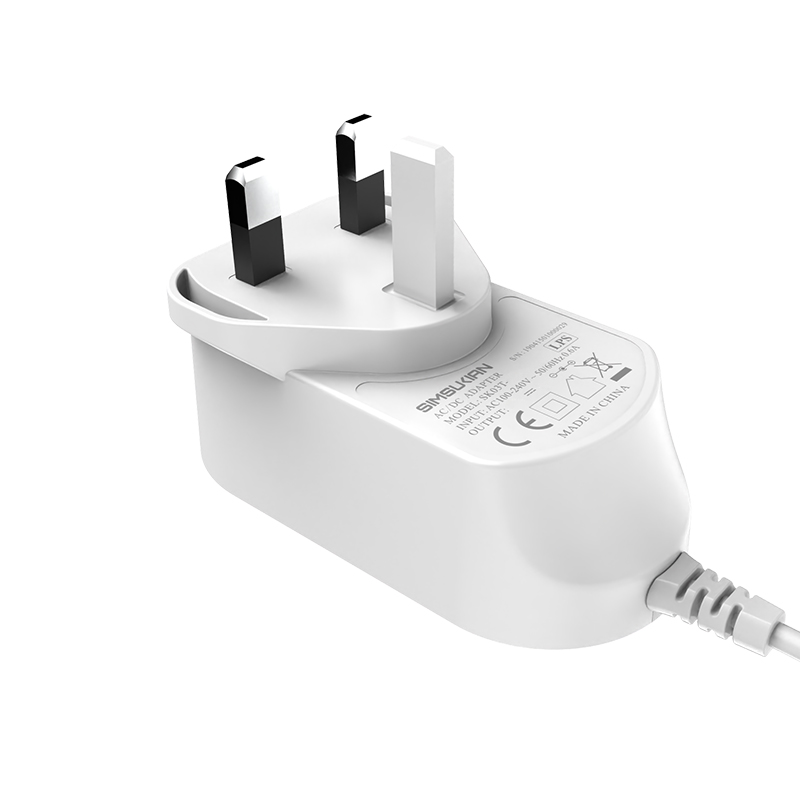
The SK03T is a 36W wall-mount switching power adapter built for manufacturing, home appliance, IT products, LED and electronics applications. The two outputs compared here are the same product platform configured to different secondaries.
24V1.5A36W (SK03T)
- Output voltage: 24V DC
- Output current: 1.5A
- Output power: 36W
- Input: AC 100–240V, 50/60Hz
- Documented AC plug versions: EU, UK, Korea
- Colours: black, white, customized
12V3A36W (SK03T / SK03T-1200300 / SK03T-1200300U)
- Output voltage: 12V DC
- Output current: 3A
- Output power: 36W
- Input: AC 100–240V, 50/60Hz
- Documented AC plug versions: EU, UK, AU, US
- Colours: black, white, customized
Shared across both configurations
- Protection set: short circuit protection, overvoltage protection and overcurrent protection.
- Housing material: fire-retardant PC, wall-mount design.
- Safety standards: IEC62368, IEC64558 and IEC60347.
- Energy efficiency: DOE, ERP and CEC-VI.
- Certificate portfolio: UL, ETL, FCC, SAA, PSE, CCC, CQC, CE-LVD, CE-EMC, and RoHS requirements.
- Customization (OEM/ODM): logo, output voltage, output current, tooling, cable length, DC plug size, cable type, colour and packaging.
The practical consequence of a shared platform is that moving a project from 12V to 24V does not mean re-qualifying an unrelated product family. The certification framework, the housing and the protection behaviour stay familiar, while the secondary side and the market-specific certificate combination change.
Market-specific certificates already on file
For buyers working through a compliance checklist, the following certificates are documented for the SK03T series:
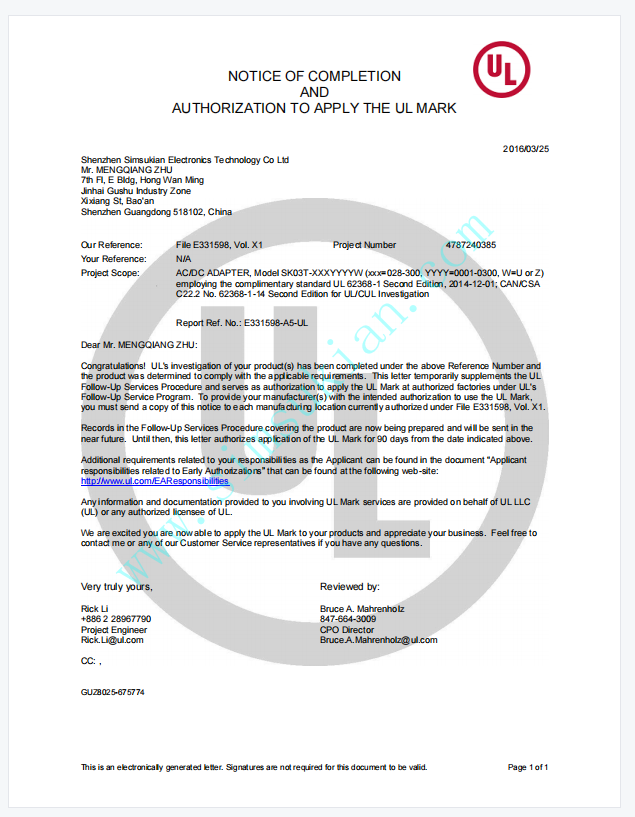
- UL – SK03T series AC/DC power adapter, certificate number E331598-A5-UL, issued by UL, applicable to the USA, Canada and Mexico markets, complying with UL 62368.
- Korea (KC) – SK03T series AC/DC power adapter, certification number R-R-SSK-SK03T1-1200300, issued by the National Radio Research Agency, applicable standard 62368, covering the Korea market.
- SAA – SK03T series AC/DC power adapter, certificate number GMA-522584-EA, issued by JAZ-ANZ, valid until 4 September 2030, applicable to Australia and New Zealand, standard 62368.
- CE-EMC (36W) – certificate number 22AE110299E002, issued by GTG, applicable to the EU and UK markets, covering EN 55032:2015+A11:2020+A1:2020, EN 55035:2017+A11:2020, EN IEC 61000-3-2:2019+A1:2021 and EN 61000-3-3:2013+A1:2019+A2:2021.
24V1.5A36W vs 12V3A36W: Side-by-Side Comparison
| Parameter | 24V1.5A36W (SK03T) | 12V3A36W (SK03T / SK03T-1200300 / SK03T-1200300U) |
|---|---|---|
| Output voltage | 24V DC | 12V DC |
| Output current | 1.5A | 3A |
| Output power | 36W | 36W |
| Input | AC 100–240V, 50/60Hz | AC 100–240V, 50/60Hz |
| Documented AC plug versions | EU, UK, Korea | EU, UK, AU, US |
| Colours | Black, white, customized | Black, white, customized |
| Housing material | Fire-retardant PC | Fire-retardant PC |
| Mounting | Wall mount | Wall mount |
| Protection | Short circuit, overvoltage, overcurrent | Short circuit, overvoltage, overcurrent |
| Safety standards | IEC62368, IEC64558, IEC60347 | IEC62368, IEC64558, IEC60347 |
| Energy efficiency | DOE, ERP, CEC-VI | DOE, ERP, CEC-VI |
| Certificates | UL, ETL, FCC, SAA, PSE, CCC, CQC, CE-LVD, CE-EMC, RoHS | UL, ETL, FCC, SAA, PSE, CCC, CQC, CE-LVD, CE-EMC, RoHS |
| Applicable industries | Manufacturing, home appliance, IT products, LEDs, electronics | Manufacturing, home appliance, IT products, LEDs, electronics |
Read the table as two variables rather than thirteen. Everything except the first three rows and the documented plug versions is common to both configurations. The buying decision therefore rests on output voltage, output current, and which plug and certificate combination the destination market demands.
Watch the plug documentation, not the SKU name. The 24V1.5A36W output is documented with EU, UK and Korea plug versions, while the 12V3A36W output is documented with EU, UK, AU and US plug versions. If a project needs a combination that is not already documented, raise it as an OEM/ODM configuration question – output voltage, tooling and DC plug design are all listed customization items – rather than assuming it from a similar-looking part number.
Plug Types and Colour Options in Practice
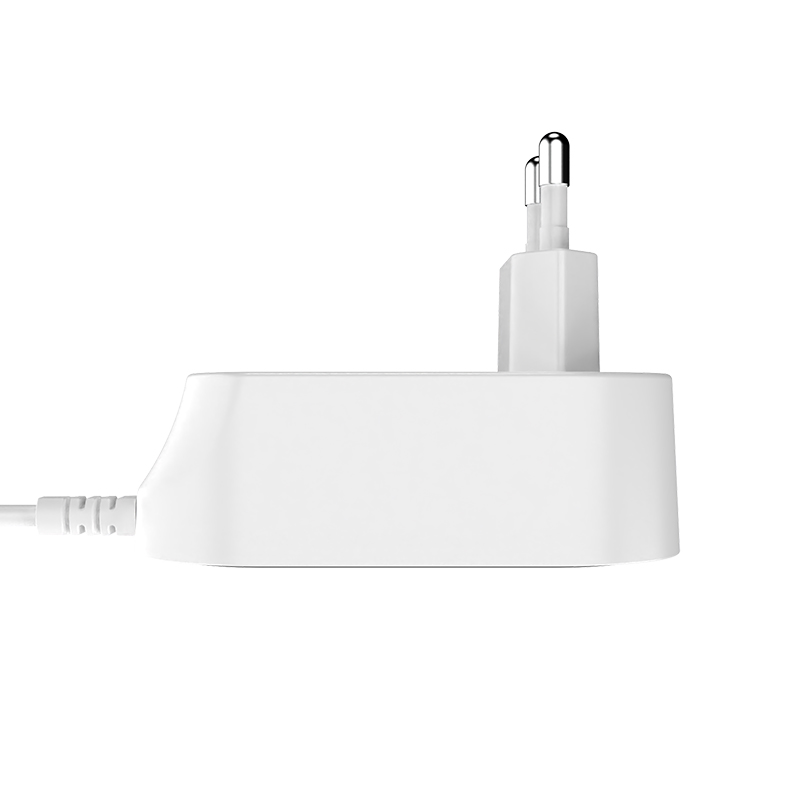
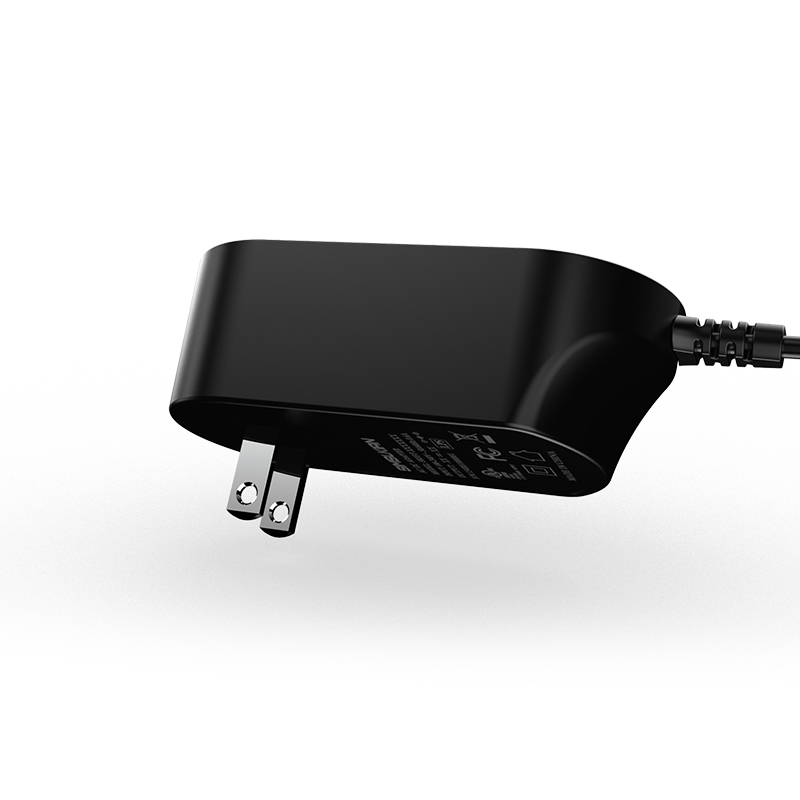
Plug type is where a technically identical 36W adapter becomes a market-specific product. Both outputs are offered in black and white as standard, with customized colours available through OEM/ODM, and both are supplied in the same wall-mount enclosure.
| Market | Plug version documented | Certification on file |
|---|---|---|
| EU / UK | EU plug and UK plug (24V and 12V) | CE-EMC 22AE110299E002 (EU and UK), CE-LVD, RoHS |
| Korea | KR plug (24V documented; alternative outputs available through customization) | KC R-R-SSK-SK03T1-1200300, standard 62368 |
| USA / Canada / Mexico | US plug (12V documented; model SK03T-1200300U) | UL E331598-A5-UL, UL 62368, FCC |
| Australia / New Zealand | AU plug (12V documented) | SAA GMA-522584-EA, valid until 4 September 2030 |
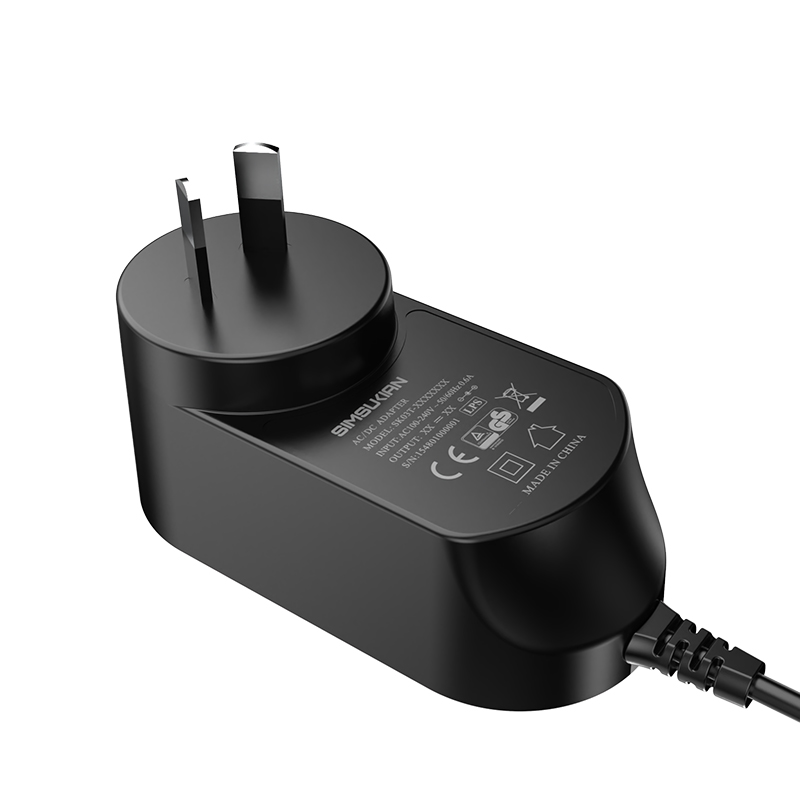
Cable Current, Voltage Drop and Connector Choice
At equal wattage, the 12V/3A configuration carries twice the current of the 24V/1.5A configuration through the DC side. Two consequences follow, and both are decided at the quotation stage rather than after delivery.
First, voltage drop scales with current for a given conductor. A longer output cable or a thinner cable will lose a larger share of the voltage on the 12V3A36W version than on the 24V1.5A36W version, and the device at the far end is the component that suffers. Where the adapter and the load are separated by more than a short tail, cable length and cable type should be specified explicitly – both are OEM/ODM customization parameters on the SK03T platform.
Second, the DC plug has to be matched to the current it will carry and to the socket on the device. DC plug size is a listed customization item, which means the correct connector can be built into the adapter rather than adapted afterwards. That is the difference between a supply that fits the first time and a supply that is returned.
Quotation checklist for a 36W adapter: rated input voltage of the device → load current with headroom → cable length and cable type → DC plug size → AC plug version → destination market certificates → colour and packaging → quantity against MOQ.
Step-by-Step: How to Select the Right 36W Variant
- Confirm the device's rated input voltage. Read the device specification, not the previous purchase order. If it says 12V DC, no commercial argument justifies 24V.
- Confirm the load current, then leave headroom. A device drawing 2.4A nominally at 12V sits inside a 3A supply; a device drawing near 3A continuously should be reviewed against thermal and derating behaviour rather than ordered against the nameplate alone.
- Check the DC side, not just the AC side. Cable length, cable type and DC plug size all affect voltage drop, especially on the higher-current 12V configuration.
- Match the AC plug to the destination market. EU, UK, Korea, AU and US plug versions are documented across the 24V and 12V configurations. A plug mismatch is the most common cause of a shipment that cannot be sold.
- Match the certificate set to the same market. UL 62368 for the USA, Canada and Mexico; CE-EMC and CE-LVD for the EU and UK; KC for Korea; SAA for Australia and New Zealand.
- Confirm efficiency compliance. DOE, ERP and CEC-VI are documented on the SK03T platform, with DOE Level VI capping no-load power at 0.100W for external supplies at or below 49W.
- Validate a sample before tooling or mass production. Confirm the electrical output under real load, the DC plug fit, the housing colour and the certificate number that will appear on the label.
- Plan the order against MOQ and lead time. The stated MOQ for this platform is 600 pcs, with a lead time of 15–30 days, a monthly capacity of 600,000 units, and 100% testing.
Where Each Output Fits: Application Scenarios
24V1.5A36W – higher voltage, lower current
- Aroma diffusers and humidifiers: a low-noise, voltage-stabilised supply keeps the atomising plate vibrating evenly, avoiding mist interruption or dry burning caused by voltage fluctuation, with all-night operation at low adapter temperature.
- Home appliances and small machines whose control boards are specified at 24V DC.
- Longer DC runs, where the lower current of the 24V output reduces voltage drop on the same conductor.
12V3A36W – where 12V is the platform standard
- IT products, routers, speakers and audio equipment running on 12V DC rails.
- LED and electronics assemblies that specify a 12V constant-voltage input.
- Indoor-use electronics projects where 12V is the established specification and 36W provides headroom over lower-current alternatives.
- Metering and control electronics: the family also includes 12V and 24V variants used in smart electricity meter, single-phase energy meter and miniature electricity meter applications for indoor use, where a stable output prevents measurement drift and display errors.
Is 36W always the right size?
Not always. The same SK03T 24V platform is also documented in a 24V1A24W version with a KR plug, for loads that do not need 36W. Over-sizing an adapter is not free: it is a heavier and larger part than the application requires. The correct sequence is therefore to size from the load – voltage first, then current, then headroom – and to treat 36W as the outcome of that calculation rather than the starting point.
Evidence from volume programmes
Two long-running supply programmes illustrate how this selection logic behaves at scale. A sports-products manufacturer has used Simsukian 12V/1A power adapters in fascia-gun applications across the US, GB, DE, PL, NL, NZ, FR and RO markets, with approximately 2,000,000 units supplied over five years and stable operation reported. A Korean medical-aesthetic equipment manufacturer has used Simsukian power adapters for dilatation and hair-removal devices, with roughly 100,000 units supplied over five years and stable operation reported. In both cases the output voltage and current were fixed by the device, and the supply programme was built around that requirement rather than around a single popular wattage.
FAQ
What certifications do the 24V and 12V 36W adapters carry?
Both configurations are documented with the same portfolio: UL, ETL, FCC, SAA, PSE, CCC, CQC, CE-LVD, CE-EMC and RoHS requirements, and both comply with safety standards IEC62368, IEC64558 and IEC60347 and with the DOE, ERP and CEC-VI energy-efficiency standards. For market-specific documentation, the SK03T series carries UL certificate E331598-A5-UL for the USA, Canada and Mexico under UL 62368; Korea certification R-R-SSK-SK03T1-1200300 under standard 62368; SAA certificate GMA-522584-EA for Australia and New Zealand, valid until 4 September 2030; and CE-EMC certificate 22AE110299E002 covering the EU and UK markets.
Can the same 36W platform be customized to a different voltage, plug or colour?
Yes. The SK03T platform supports OEM/ODM customization covering logo, output voltage, output current, tooling, cable length, DC plug size, cable type, colour and packaging. Black and white are standard, and customized colours are available. This is the route to follow when a project needs an output or plug combination that is not already documented as a standard SK03T version, since the design is not locked to the currently published plug list.
Does choosing 24V or 12V change the cost drivers of a 36W order?
Both outputs come from the same 36W platform, so the variables that move a quotation are configuration and compliance rather than wattage: the plug version, the cable and DC plug specification, the colour and packaging, the number of certificate markets the order must support, and the order quantity against the 600 pcs MOQ. Buyers comparing quotations should ask each supplier to itemise those configuration points instead of comparing a single unit figure.
Can I validate both outputs with samples before committing to mass production?
Sample validation is the practical way to confirm output voltage and current under the real load, DC plug fit, cable length and colour before tooling or volume orders are placed. Buyers can request a sample and a quotation through the contact details below, and the SK03T specification set is published in the Simsukian power adapter catalogue, which can be downloaded from the link at the end of this article.
What are the MOQ and lead time for a 36W adapter order?
The stated MOQ for this platform is 600 pcs, with a lead time of 15–30 days, a monthly capacity of 600,000 units and 100% testing. Lead time should be planned against the certificate requirements of the destination market, because market-specific documentation is what most often extends a first order.
Conclusion
At 36W, the 24V versus 12V question is a matching problem, not a performance contest. The 24V1.5A36W configuration delivers the same 36W at half the current of the 12V3A36W configuration, which makes it the natural choice where the device is specified at 24V or where a longer DC run needs lower voltage drop. The 12V3A36W configuration is the answer where 12V is the platform standard across IT products, LED assemblies and electronics. What both share – the AC 100–240V 50/60Hz input, the fire-retardant PC wall-mount housing, the short circuit, overvoltage and overcurrent protection, the IEC62368/IEC64558/IEC60347 safety basis, the DOE/ERP/CEC-VI efficiency compliance and the UL, ETL, FCC, SAA, PSE, CCC, CQC, CE-LVD, CE-EMC and RoHS portfolio – is what makes the comparison narrow and the decision fast.
Next step: confirm your 36W configuration.
Download the Simsukian power adapter catalogue for the full SK03T specification set and certificate list: Simsukian PD catalogue (PDF).
For samples, quotations or a configuration review, contact Simsukian: Abby, email 8042@simsukian.com, tel +86 173-2838-5323, WhatsApp +86 17388780986, or visit www.simsukianpower.com. Manufacturer: Shenzhen Simsukian Electronics Technology Co., Ltd., #27 Guifu Rd, Guanlan, Longhua, Shenzhen, China, 518110.
Have Questions or Need More Details?
Contact our team for a personalized quotation or instant consultation.
Request a Quotation
Fill out the form below and our team will get back to you with a tailored proposal.
WhatsApp Direct Chat
Prefer to chat in real-time? Message us on WhatsApp for instant assistance & quick answers.
- Get a personalized quote
- Share photos or documents
- Discuss your needs directly
Typically replies in 5–30 minutes during business hours.