36W Wall-Mount Adapter Specs: Input, Output, Protection
A 36-watt wall-mount adapter is fully described in three specification lines: what it accepts from the wall, what it delivers to the load, and what it does when the load misbehaves. Reading them in that order is how a design engineer confirms a part and how a buyer avoids ordering the wrong one.
This guide reads each line against the SK03T 36W series from Shenzhen Simsukian Electronics Technology Co., Ltd (Simsukian), a power adapter manufacturer founded in 1996 whose range covers switching power supplies and AC-DC adapters. The series includes a 24V/1.5A build and a 12V/3A build that both land on 36W, which makes it a useful reference for the parts of a specification buyers most often skip: how output voltage is matched to a device load, what the protection entries actually commit the adapter to, and what to confirm on the datasheet before an OEM/ODM order for custom colors and plug types.
36W Is a Ceiling, Not a Description
Two SK03T builds carry the same wattage and are not interchangeable: 24V at 1.5A and 12V at 3A both equal 36W. The model is correctly classified as a 36W power adapter. The figure is accurate, but it describes the maximum the unit can deliver, not the voltage a device will receive. A purchase order reading “36W adapter” has therefore not specified a part.
Voltage is set by the design. Current is a capability: the adapter can supply up to 1.5A or up to 3A, and the device draws only what its own circuit demands. The asymmetry matters in both directions. A device rated for 24V fed from a 12V build will not start; a device rated for 12V fed from a 24V build is at risk of damage. Both errors are visible on the nameplate and invisible on a quotation.
What the 36W classification does establish is the power budget. Whatever the load is, its continuous draw has to sit inside 36W, and its rated voltage has to equal the build's output voltage. Everything else on the label — plug, housing, color, protection — sits around those two facts rather than replacing them.
Read the specification in the order a fault travels: input from the mains, output to the load, protection as the last barrier before damage. Mechanical details come after, because they decide where the unit can be installed, not whether it will work.
Line 1 — Input: AC 100–240V, 50/60Hz
The adapter accepts an input of AC 100–240V, 50/60Hz. That single window is the reason one electrical design can serve five export markets: EU and UK mains at 230V, US mains at 120V, Australian mains at 230V and Korean mains at 220V all fall inside it. What changes between those shipments is the plug, not the input specification.
The commercial consequence is worth stating plainly. Separate 120V and 230V builds double the part numbers and split the approval documentation; one universal-input design with regional plugs keeps a single electrical base per variant. The SK03T 36W product set carries EU, UK, US, AU and KR plug configurations for exactly this reason, and the plug is the item to specify per destination market.
Frequency behaves the same way. 50/60Hz covers the 50Hz grids used across Europe and much of Asia-Pacific as well as the 60Hz grids used in North America. A datasheet quoting only “230V” or only “50Hz” has quietly narrowed the part; ask for the range in writing.
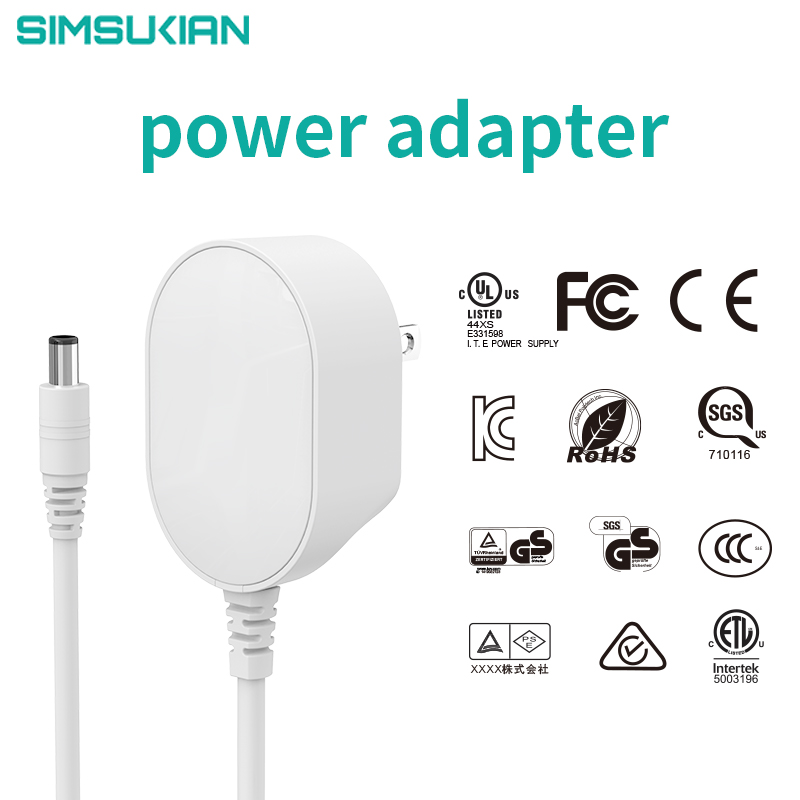
Efficiency sits on the same line. Simsukian states that the adapter complies with DOE, ERP and CEC-VI energy-efficiency standards. Those marks carry defined limits rather than vague intent: under the US Department of Energy Level VI rules, external power supplies at or below 49W are capped at 0.100W no-load power, so a compliant 36W unit has a measurable standby ceiling. Safety follows the same structure. IEC 62368-1, in its 4th edition since 2023, is the hazard-based standard that replaced the 60950 and 60065 approach for AV and ICT equipment, and the SK03T certificates are issued against the 62368 standard.
Line 2 — Output: 24V/1.5A Versus 12V/3A
Output is where the 36W split becomes a decision rather than a number. Four checks resolve most cases.
Match voltage to the device's rated input. The 24V/1.5A build suits a load specified at 24V; the 12V/3A build suits a load specified at 12V. Nothing on the adapter changes this, because the output voltage is fixed by the design rather than set by a switch or a jumper.
Size current to the load, not to the maximum on the label. A 12V device drawing roughly 1.2A runs from a 12V/3A build with visible headroom; a device drawing 2.8A sits close to the ceiling with little margin for startup peaks or a warm enclosure. Headroom is ordinary engineering practice rather than a datasheet value — the device's own current profile has to come from the equipment side.
Check the total against 36W. Voltage multiplied by current gives 36W for both builds, so the power budget does not separate them. What separates them is the current that must pass through the lead and DC connector. At the same wattage, 24V/1.5A carries half the current of 12V/3A, which reduces resistive (I²R) loss along the cable. That is a practical reason 24V builds appear where the lead is long. It is not a reason to prefer one build: the device's voltage requirement decides first, and the cable is then specified around it.
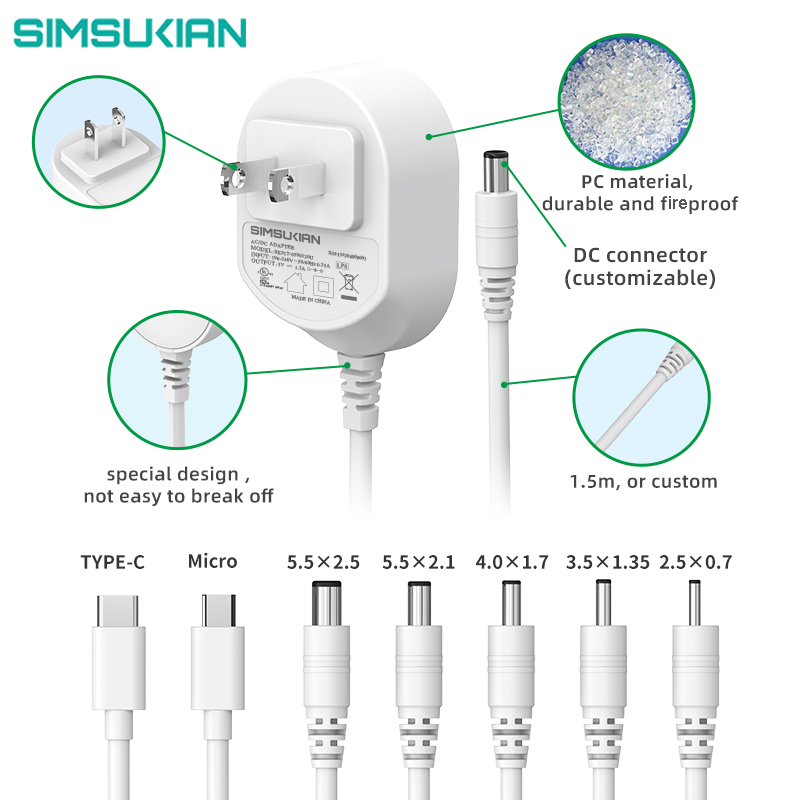
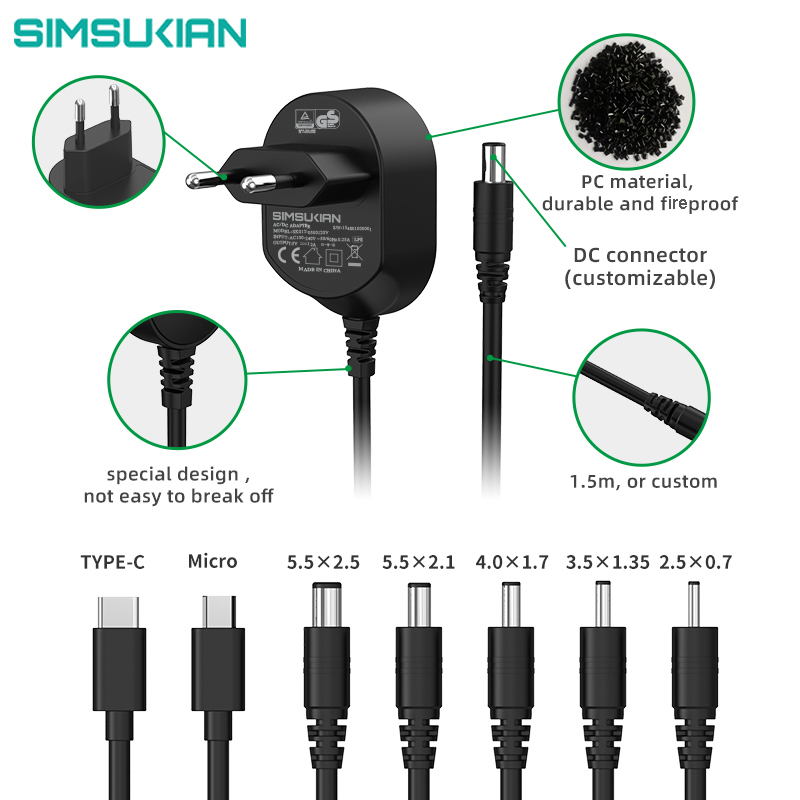
Confirm the connector and lead on the order. DC plug size, cable length and cable type are customization items, not universal defaults. Fixing them at quotation avoids a second shipment and a repeat approval.
A short worked path shows how the four checks combine. Take a 12V router rated at 1.5A: the 12V/3A build matches the voltage and leaves margin on current. Take a 24V control unit rated at 1A: the 24V/1.5A build matches the voltage and again leaves margin. Reverse either pairing and the specification fails at the first check, before protection or plug type are even discussed.
| Specification | 24V / 1.5A build | 12V / 3A build |
|---|---|---|
| Output voltage | 24V | 12V |
| Output current | 1.5A | 3A |
| Rated power | 36W | 36W |
| Current on the output lead | Lower at the same wattage | Higher at the same wattage |
| Load match | Devices rated 24V | Devices rated 12V |
| Plug configurations in the supplied 36W product set | EU, UK, KR | EU, UK, US, AU |
| Housing material | Fire-retardant PC | Fire-retardant PC |
| Colors | Black, white, customized | Black, white, customized |
Plug configurations reflect the variants listed for each build in the supplied 36W product set. A required combination outside those listings is an OEM/ODM quotation item, not an assumption to make from the series name.
Line 3 — Housing and Protection
The SK03T housing is made of fire-retardant polycarbonate (PC). The material does two jobs at once: it gives a wall-mount body its mechanical durability, and it limits how the enclosure behaves if an internal fault generates heat. The adapter is intended for indoor use, a condition that belongs in the installation plan rather than in a footnote.
Protection entries are the least standardized part of any adapter datasheet and the easiest to under-read. Three categories matter on a fixed-voltage 36W unit.
Short-circuit protection. A damaged lead, a pinched cable or a failed connector can short the output. The adapter must then limit or interrupt output rather than deliver current without limit. Simsukian's in-house safety and reliability laboratory runs short-circuit testing, alongside EMC, thermal cycling, surge and accelerated-aging tests, on every new design before mass production, and the company holds more than 90 national patents covering structural design, circuit topology and safety-protection technologies. For a buyer, the follow-up question is what happens once the short is removed: auto-recovery or latch-off. Both are legitimate; they fit different equipment.
Overcurrent protection. A load that pulls more than its rating — a stalled motor, a failing board — should meet current limiting rather than sustained overload. Simsukian's stated R&D scope includes over-protection circuits, and production is 100% tested. The datasheet should add the threshold and the recovery behaviour, so the equipment designer can check the adapter will not trip on normal startup peaks.
Overvoltage protection. Regulation holds the output at 24V or 12V; overvoltage protection is the response when regulation is disturbed. Ask whether it clamps or shuts down, and whether recovery needs a power cycle. On equipment with expensive downstream electronics, knowing which behaviour you bought matters more than the reassurance of a single word on a label.
One boundary applies to all three. A protection feature is a defined behaviour, not unlimited tolerance. The supplied material for the SK03T series does not publish protection thresholds, so those values should be requested from the manufacturer and recorded against the model number before approval. An unpublished threshold is not evidence that protection is absent — it is a question for the quotation stage.
Plug, Color and the OEM/ODM Order
Mechanical configuration is where a technically correct adapter still fails to ship. The SK03T 36W series is available in black, white or customized colors, in EU, UK, US, AU and KR plug configurations, and Simsukian supports OEM and ODM services across the platform.
The customization scope is broader than the shell: logo, output voltage, output current, tooling, cable length, DC plug size, cable type, color and packaging. That breadth only helps if the request is written precisely. “White, EU plug, 12V/3A, fixed cable, specified DC plug” is an order. “White 36W adapter” is an enquiry that will generate a second round of questions.
| Destination market | Plug configuration | Certificate held for the SK03T series |
|---|---|---|
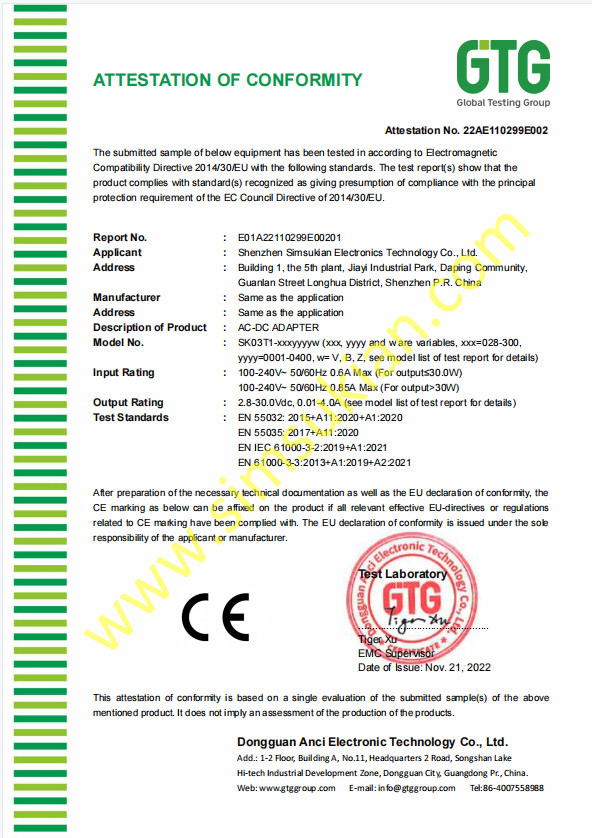
| EU and UK (EMC scope) | EU, UK | CE-EMC, certificate 22AE110299E002, issued 21 Nov 2022 |
| USA, Canada, Mexico | US | UL, certificate E331598-A5-UL, standard 62368, valid to 1 Jun 2028 |
| Korea | KR | KC, certificate R-R-SSK-SK03T1-1200300, standard 62368, valid to 1 Jun 2035 |
| Australia, New Zealand | AU | SAA, certificate GMA-522584-EA, standard 62368, valid to 4 Sep 2030 |
Certificate validity is a purchasing item, not a formality. The UL certificate for the SK03T series runs to 1 June 2028, the KC certificate to 1 June 2035 and the SAA certificate to 4 September 2030; the CE-EMC certificate 22AE110299E002 was issued on 21 November 2022 against the EN 55032, EN 55035 and EN 61000-3 series standards. If a programme runs past one of those dates, renewal timing belongs in the supply agreement rather than in a later email.
What to Verify on the Datasheet Before Ordering
Specification reading turns into procurement risk at the point where a certificate number and a model number stop matching. Work through these checks in order:
- Model-to-certificate match. Confirm the certificate names the SK03T series, or the exact variant, for the plug and output being purchased.
- Input range and frequency, written as a range covering both 50Hz and 60Hz.
- Output voltage and current as a pair, with rated power stated: 24V/1.5A/36W or 12V/3A/36W.
- Protection set: short circuit, overcurrent and overvoltage, plus recovery behaviour and thresholds where published.
- Housing material and the indoor-use condition.
- Efficiency mark — DOE, ERP or CEC-VI — recorded on the datasheet that will be filed.
- Lead and connector: cable length, cable type and DC plug size, all customizable items.
- Color and packaging, stated as explicitly as the electrical specification.
- Commercial terms: MOQ 600 units, lead time 15–30 days, delivery terms EXW Shenzhen, FOB Shenzhen or DAP, and payment at 30% T/T in advance with 70% against copy of B/L.
- Acceptance evidence: factory inspection reports, pre-shipment testing and support for third-party inspection before shipment.
Capacity supports that timeline: the stated monthly capacity is 600,000 units, production is 100% tested, and after-sales support is handled remotely. Quality management is certified to ISO 9001:2015 and environmental management to ISO 14001:2015, which is the documentation layer behind the inspection reports a buyer actually receives.
Where a 36W Wall-Mount Adapter Fits
The SK03T 36W is designed for applications in manufacturing, home appliances, IT products, LEDs and electronics, and it operates under indoor conditions. Those categories share a requirement rather than a product type: a fixed, regulated voltage at modest power, delivered from a wall outlet instead of a bench supply. Within that envelope the choice between builds follows the device nameplate — 24V equipment takes the 24V/1.5A build, 12V equipment the 12V/3A build — and the plug follows the installation market.
Frequently Asked Questions
Which markets can the SK03T 36W adapter ship to, and which certificates cover them?
The SK03T series holds UL (US, Canada, Mexico), KC (Korea), SAA (Australia and New Zealand) and CE-EMC (EU and UK scope) certificates issued against the 62368 standard, and Simsukian states compliance with DOE, ERP and CEC-VI energy-efficiency standards. Confirm the certificate number against the exact plug and output variant on the order, since approvals are tied to the model they name.
Can the same 36W design be ordered as 24V/1.5A and 12V/3A, and are all plug types available on both?
Both builds exist in the SK03T 36W series, and both deliver 36W. In the supplied product set, the 24V/1.5A variants are listed with EU, UK and KR plugs, while the 12V/3A variants are listed with EU, UK, US and AU plugs. A combination outside those listings is a configuration question for the OEM/ODM quotation, not something to assume from the series name.
USB charger OEM manufacturer for private label — what can be customized?
Simsukian supports OEM and ODM services, with customization covering logo, output voltage, output current, tooling, cable length, DC plug size, cable type, color and packaging. MOQ is 600 units and lead time is 15–30 days. The company's main products include power adapters, AC-DC power supplies, PD chargers and fast chargers, so a private-label brief should state which product family and which output rating it covers before tooling and packaging are discussed.
What test and inspection evidence can be requested before approving an order?
Factory inspection reports, pre-shipment testing and support for third-party inspection before shipment. Production is 100% tested, and every new design passes an in-house sequence covering EMC, thermal cycling, surge, short-circuit and accelerated aging before mass production.
What are the MOQ, lead time and payment terms?
MOQ is 600 units, with a 15–30 day lead time and a stated monthly capacity of 600,000 units. Delivery terms include EXW Shenzhen, FOB Shenzhen and DAP, and payment is 30% T/T in advance with 70% against copy of B/L. The product catalogue covers the wider range, and a specific 24V/1.5A or 12V/3A configuration can be quoted against the plug, color and connector a project needs; technical questions can be sent to gpe@simsukian.com.
Conclusion
Reading a 36W wall-mount adapter means separating three questions that the label answers in sequence. Input tells you where the unit can be installed: AC 100–240V at 50/60Hz covers EU, UK, US, AU and KR mains, with only the plug changing. Output tells you whether it fits the device: 24V/1.5A and 12V/3A are the same wattage and different products, and the device nameplate decides between them. Protection tells you what happens when the load or the lead fails, and it is the line most often reduced to a single word on a datasheet.
The SK03T series answers all three with documented evidence: 62368-based UL, KC, SAA and CE-EMC certificates, fire-retardant PC housing, an indoor-use rating, and a design and validation process that includes short-circuit, surge and accelerated-aging testing. What remains is the buyer's work — request the thresholds that are not published, match the certificate to the exact variant, and write the plug, color, lead and connector into the order instead of leaving them to interpretation.
Have Questions or Need More Details?
Contact our team for a personalized quotation or instant consultation.
Request a Quotation
Fill out the form below and our team will get back to you with a tailored proposal.
WhatsApp Direct Chat
Prefer to chat in real-time? Message us on WhatsApp for instant assistance & quick answers.
- Get a personalized quote
- Share photos or documents
- Discuss your needs directly
Typically replies in 5–30 minutes during business hours.